

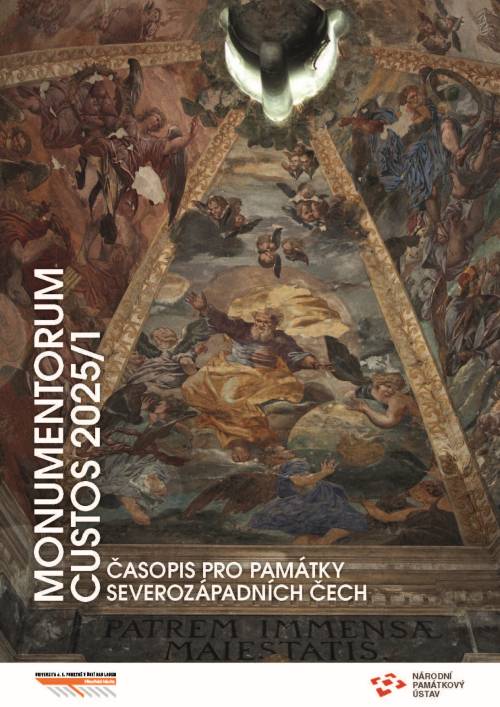
Published November 2025.
Contents
The interwar housing crisis and attempts to resolve it, as exemplified by municipal construction in the city of Děčín
Marta Pavlíková – Alena Sellnerová – Jiří Bureš
The interwar housing crisis and attempts to resolve it, as exemplified by municipal construction in the city of Děčín in Monumentorum Custos 2025/1, pp. 3-17; Studies
A study based on the example of the city of Děčín shows how housing policy was formed in Czechoslovakia between 1918 and 1938 in the context of specific regional conditions and economic constraints. Děčín is a model example of an important administrative center in northern Bohemia, where the development of social housing was conditioned not only by the postwar economic and political situation, but also by demographic changes, urban planning limitations, and complex ethnic relations. Despite its limited resources, the local government initiated a number of housing projects in the interwar period, which contributed significantly to improving the bleak social situation and alleviating the housing shortage. Although many of these projects, especially those from the 1920s, were hampered by the city‘s financial limitations, most of them contributed to the overall improvement of the housing stock in Děčín and provided one of the highest standards of living for a long time after their completion. Using specific examples and detailed archival research, the authors demonstrate that solving the housing crisis was not purely a technical and economic problem, but a complex cultural and social challenge.
Painted decoration of the interior of the Holy Trinity Chapel in Chlumec
Vít Honys
Painted decoration of the interior of the Holy Trinity Chapel in Chlumec in Monumentorum Custos 2025/1, pp. 18-33; Studies
This study examines the previously neglected painted decoration of the interior of the Chapel of the Holy Trinity on Horka Hill in Chlumec near Ústí nad Labem, whose architectural design was recently attributed to J. B. Mathey. No direct archival sources have been preserved concerning the construction of the chapel, including its decoration, which was initiated by Jan František Krakovský of Kolovrat and his wife Marie Eleonora and completed in 1691. Therefore, the recent discovery of the signature of painter Jan Jakub Stevens of Steinfels on the painted group of prophets on the eastern wall, made through photographic documentation, is significant. The painted decoration, executed mainly in fresco technique, covers the walls and vault with an illusory architectural structure with figural scenes in cartouches and illustrates the verses of the Te Deum hymn written on the frieze and illusory jambs. but the inscription component also contains, in addition to commemorative inscriptions, the final verse of the hymn Pange Lingua and the beginning of the prayer Glory be to the Father.
The paintings were completely repainted in 1899–1901 during the restoration of the chapel, but the original paintings were the as yet unknown work of the above-mentioned painter of Baroque iconological cycles, and were the only ones to cover not only the vaults but also the interior walls. The arrangement of verses and scenes from the Te Deum hymn, based on the principle of predominantly horizontal symbolic triangles at different heights, is also unique in Central Europe at that time, emphasizing the Trinitarian symbolism of the chapel’s patronage, whose historical value is significantly increased by the aforementioned discovery and related facts. The aforementioned repainting will also require a careful approach in the context of the anticipated restoration in the future.
Heritage education as a path to understanding history and cultural heritage: an example from Ústí nad Labem and Krupka
Kamila Budilová Mlejnková – Tereza Peerová
Heritage education as a path to understanding history and cultural heritage: an example from Ústí nad Labem and Krupka in Monumentorum Custos 2025/1, pp. 34-41; Reports
The article focuses on heritage education as a key tool for improving public perception of cultural heritage, specifically among children. The aim is to transform the view of monuments from "lifeless objects" to witnesses of history and to build a relationship with them through authentic stories and interactivity. The National Heritage Institute in Ústí nad Labem therefore implemented three educational programs in 2024. The Krupka, Capital of Tin program introduced students to mining history and UNESCO monuments through field and experiential activities. A walk down Winston Churchill Street connected villa architecture with the fates of local industrial elites. The third program, Ústecké procházky (Walks in Ústí), targeted younger students through a creative interpretation of the city center. Nearly 250 students participated in the programs. The results confirm that combining theory with personal experience successfully strengthens children's relationship to the region, develops their critical thinking, and increases their awareness of the need to protect monuments.
Annual Report of the Centre for Documentation and Digitization of Cultural Heritage
Veronika Chalupová
Annual Report of the Centre for Documentation and Digitization of Cultural Heritage in Monumentorum Custos 2025/1, pp. 42-48; Reports
The 2025 Annual Report summarizes the activities of the Center for Documentation and Digitization of Cultural Heritage at the Faculty of Arts, University of Jan Evangelista Purkyně. The center focused on two main research projects. As part of the NAKI Finis Confessionis project, it documented sacred monuments in the eastern Ore Mountains and created a model of the defunct church in Nakléřov. The Region to the University, University to the Region project focused on recording the remains of coal mining and, in cooperation with the city of Most, explored the possibilities of returning transferred objects to the landscape. A new student grant project was launched to map the industrial history of Chabařovice using foreign sources. The center also carried out professional commissions, including the construction survey of the rectory in Tišice, houses in Zákupy and Zubrnice, and a building in Ploskovice Castle. Educational activities were an integral part of the center's work. Students completed field studies at the castle in Benešov nad Ploučnicí and a ten-day internship at the Osek monastery, where 29 students learned methods of documenting historical monuments.
Memory of Ingrid Augstenová
Věra Brožová – Petra Chourová
Memory of Ingrid Augstenová in Monumentorum Custos 2025/1, s. 49-56; Interviews
The interview presents a remembrance of Ingrid Augstenová (1940–2025), a significant figure in heritage preservation in the Ústí region. It recalls her forty-year professional career, including supervising the relocation of the church in Most, the rescue of Grabštejn Castle, and the restoration of the synagogue in Úštěk. The text also explores her personal life, her specific approach to the field, and her indomitable nature.